The Lazy Susan, a rotating kitchen tray, has a rich history dating back to 18th century England, enhancing modern modular kitchen functionality.
Key Insights:
What You'll Read Here:
- A mahogany Lazy Susan from the 18th century sold for Rs. 3,900 in 2010, highlighting its historical value.
- Materials like wood, metal, and ceramics were used, adapting to diverse kitchen designs and price points.
- Modern use includes spice racks and corner cabinet solutions, optimising storage and accessibility in kitchens.
HOMELANE EXPERT TIP By our design team
Incorporate a Lazy Susan into your kitchen’s L or U-shaped corner cabinets to maximise often-wasted space and ensure effortless access to stored items.
Lazy Susan – Who was that woman, and was she really lazy? For those kitchen aficionados searching for some mystery to solve, this is a very intriguing one. Lazy Susans have been a part of kitchens for centuries. Their popularity just doesn’t seem to abate and manufacturers are finding new and interesting ways to incorporate them into standard kitchens, enhancing both functionality and kitchen interior design.
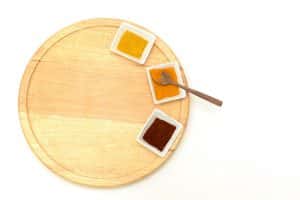
As much as they are popular, there is also not much information about them. The design’s origins remain very elusive, and as far as imagination goes, this term could have been coined for a lady who invented turntables to take over much of her work and got an unsavoury adjective added to her name while at it.
While many people commonly think that this kitschy design traces its history to just a couple of decades ago, in reality, it has a very distinguished and chequered past that stretches long before that. Historians have even been able to trace it to 18th century England where the term, ‘ Dumbwaiter’ was most probably used. Lazy Susans may have been popular when the era of having many servants for household needs gradually began to decline. With maids and footmen no longer available to do ordinary chores such as transferring wine goblets and serving small bites, it became necessary for people not to be inconvenienced with the lack of household help, the chores of whom Lazy Susans took over.

Plenty of instances corroborate this fact, prime among them being the sale of a mahogany Lazy Susan that sold for $3,900 in 2010 which was traced to the 18th century. Sarah Coffin, head of product design at the Cooper-Hewitt National Design Museum believed that they were a 20th-century invention, but also found many of these which dated back to 1730’s England. She came across many such pedestal tables that were fitted with rotating tops as well as silver plates embedded into table surfaces in the course of her work at the museum. She also believed that lazy susans were replacements for house help.
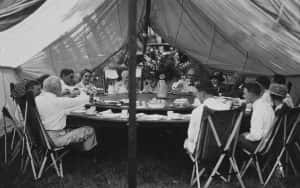
An interesting anecdote in the history of lazy susan is that of Henry Ford, founder of automobile company ‘Ford Cars’. With a retinue of servants always following him around, he found it rather inconvenient to take them along to the forests while camping with friends. His clever replacement for them was a large round 9-foot table fitted with a large turntable on the top, so guests could serve themselves. There are even photographs of him in the 1920s to corroborate this fact.
Lazy Susans as many believe were just a way for Southern Californian people to merge an indoor and outdoor lifestyle in the 1950s. They were crafted out of wood, metal, and even ceramics, and varied from small delicate ones that could grace a kitchen counter to large rotating dishes placed on wood or metal trays, making them adaptable additions across different modular kitchen design price ranges. Today, this design is a handy and convenient part of modern modular kitchens. Although its main use is as a cake turntable in cake decoration, smaller ones are used as spice racks, and semi-circular turntables also called moving corners, are used in L shaped and U shaped kitchen corner cabinets, to aid in the convenient and ergonomic storage of food and kitchen appliances.
FAQs On Lazy Susan
1. What is a Lazy Susan in kitchen design?
A Lazy Susan is a rotating tray or turntable used in kitchens to easily access items stored in cabinets or on countertops. It is especially useful in corner cabinets, helping maximise storage space and improve accessibility without the need to reach deep inside.
2. Why is a Lazy Susan useful in modern kitchens?
A Lazy Susan improves kitchen efficiency by allowing quick access to stored items like spices, condiments, or cookware. It reduces clutter, enhances organisation, and makes use of hard-to-reach corners, making it a practical addition to modular kitchens.
3. Where can you use a Lazy Susan in the kitchen?
Lazy Susans are commonly used in corner cabinets, pantry units, and countertops. They can store spices, jars, utensils, or even baking tools. Larger versions are also used in dining settings to share food conveniently.
4. What are the different types of Lazy Susan?
There are several types of Lazy Susan designs, including full-circle, half-moon, and multi-tier rotating trays. Some are fixed inside cabinets, while others are portable and used on countertops for spices or condiments.
5. Is a Lazy Susan suitable for small kitchens?
Yes, a Lazy Susan is ideal for small kitchens as it helps optimise unused corner spaces. It increases storage capacity without taking up extra room, making it a smart solution for compact kitchen layouts.


























 EXPLORE MORE