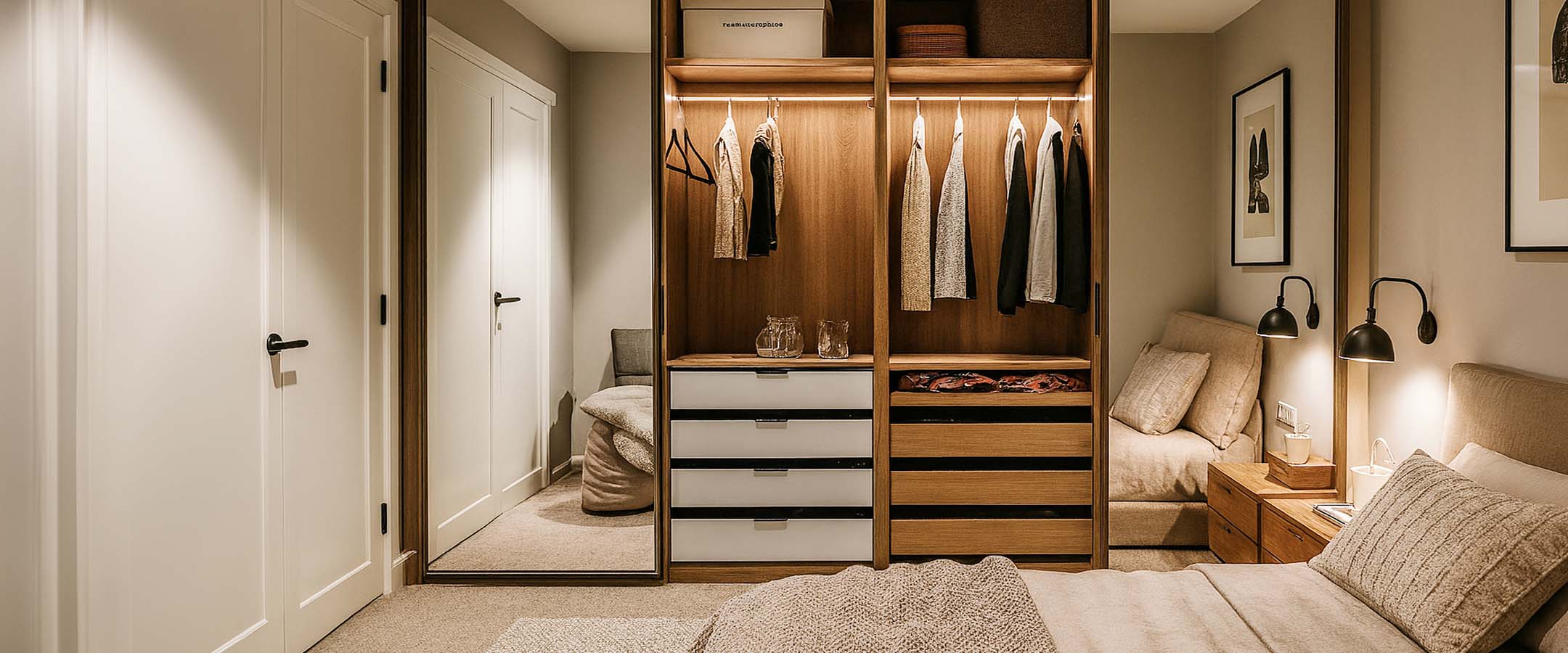
Popular Wardrobe Designs in Kathmandu
Size | 13' X 12'
Why Choose HomeLane for Your Wardrobes in Kathmandu?
Delivery in 45 days*
No hidden costs
Flat 10-year warranty
Easy EMIs
What Goes Into a Well-Made Wardrobe
Strong Wardrobe Materials
Wardrobe design isn’t something you redo often. It has to handle humid monsoons, dusty summers, and daily wear without giving up on you. That’s why we use moisture-resistant plywood, sturdy MDF, and Hydroguard Plus, our in-house material built for Indian conditions. HomeLane wardrobes are built to last - no sagging shelves, no creaky shutters, just everyday strength you can count on.
Sleek Wardrobe Finishes
From warm wood grains to sleek glossy shutters, we’ve got wardrobe finishes that match your style and handle the realities of Indian homes - dust, humidity, and even tiny sticky fingers. With HomeLane, beauty and durability live side by side.
Hardware That Lasts
Great wardrobe design needs great hardware. We use smooth channels, soft-close hinges, and sturdy handles that won’t rust or loosen over time. Your wardrobe opens like butter, shuts like a whisper- even when your kid slams it shut. Every part is built to last, so you don’t have to worry later.
Brands we trust: Tyrox (by HomeLane), Hettich, Hafele, Ebco, Blum.
Space-Saving Accessories
This is where a good wardrobe gets even better. Think tie and trouser pull-outs, hidden drawers, pull-down hangers, mirror pull-outs, and built-in ironing stations—smart add-ons that make everyday life easier. No more digging through piles of clothes. Even a compact wardrobe can feel like a walk-in, with the right touches.
Brands we trust: Tyrox (by HomeLane), Hafele, Hettich, Blum, Spitze.
Which Wardrobe Design Works Best for Your Home?
Every home is different, and so is every wardrobe. Whether you live in a cosy 2BHK or have the luxury of a large master bedroom, we’ve got styles to suit your space, storage needs, and everyday routine.
Sliding Door Wardrobes
Ideal for compact rooms where swing space is tight. These wardrobes glide open smoothly and lend a sleek, modern look - perfect for city apartments or shared bedrooms.
Hinged Wardrobes
A timeless option that works well in most Indian homes. The doors open wide, so you can see everything at once - great for people who like to keep things organised and easy to access.
Walk-in Wardrobes
If you’ve got the room, a walk-in is pure indulgence. Think dressing area, mirror space, and separate zones for his-and-hers storage. It brings that luxury, boutique-hotel feel right into your home.
L-Shaped Corner Wardrobes
Perfect for making awkward corners useful. These wardrobes give you ample storage without eating into floor space - ideal for kids’ rooms or oddly-shaped layouts.
Loft Wardrobes
Most Indian homes need space for suitcases, winter clothes, or extra bedding. A loft wardrobe adds that extra storage up top, without cluttering your room.
Custom Wardrobes Designed Around You
Meet Our Expert Designers:
The Minds Behind the Magic
Know Your Wardrobe Costs Instantly
55000+ Homes Designed with Love
Take a closer look at the homes we've designed for our happy customers. Hear their experiences, see the before-and-after magic, and find out how HomeLane brought their visions to life.
Our Trusted Partners
FAQs on Wardrobe Design in Kathmandu
What is the average cost of a modular wardrobe in Kathmandu homes?
There’s no standard “average” wardrobe price in Kathmandu because the inside of the wardrobe can change the budget as much as just its size! But as a thumb rule, a 2-door hinged wardrobe might cost around 98,000 NPR.
A simple unit with shelves and a hanging rail is priced low. Add full-height shutters, drawers, a loft, mirrors, shoe storage and premium hardware, and you’re looking at a higher number.
Ask your HomeLane designer for a custom quote, based on what you need to store. It’s a far better way to kickstart your budget planning. For an instant quote, use our handy tool.
Are sliding wardrobes suitable for compact apartments and modern homes in Kathmandu?
Yes. Sliding wardrobes can be a great fit for compact Kathmandu bedrooms because you don’t need to leave space in front for the shutters to swing open.
They’re particularly handy when:
- The bed sits fairly close to the wardrobe
- You want a wide wardrobe without several doors
- A mirrored shutter would be useful
- You want storage right up to the ceiling
- Your room has limited walking space
Your wardrobe designers in Kathmandu will always pay particular attention to the tracks and sliding hardware. Try the shutters before you approve them. They should glide easily without feeling flimsy.
These interiors by HomeLane show you how it’s done!
Which wardrobe finishes are best for Kathmandu’s climate and seasonal humidity?
For Kathmandu, wardrobe finishes should be easy to maintain and teamed with a suitable core material and good edge finishing. Laminate is a dependable everyday option, while acrylic, PU and veneer can be used when you want something more decorative.
For wardrobe interiors in Kathmandu, don’t choose from the shutter sample alone. Ask what’s underneath it, how the edges are finished and what hardware is being used.
Important: Also take a good look at the wall before the wardrobe goes in. If there’s existing dampness, seepage or mould, fix that first. It sounds obvious, but it’s often overlooked! A lovely new wardrobe installed against a problem wall is still a wardrobe installed against a problem wall.
What wardrobe colours work best for Kathmandu homes to create a fresh and airy look?
Large wardrobes don’t have to look like large wardrobes. The right colour combination can help them sit much more lightly in the room.
For modern wardrobe designs in Kathmandu, try:
- Ivory with pale timber
- Warm white with oak
- Soft sage with cream
- Light grey with wood grain
- Beige or mushroom tones
- A light finish broken up with a mirrored panel
But if you love darker timber, you can absolutely use it. Consider limiting it to one section, trims or a central panel rather than covering a whole wall.
And look around before choosing. The wardrobe has to live with your flooring, bed, curtains and wall colour every day. It doesn’t need to match them, but it shouldn’t look as though it wandered in from another bedroom!
Which wardrobe door type is ideal for Kathmandu homes: hinged, sliding, or folding?
Choose the wardrobe door after you’ve positioned the bed in the room, and know how much circulation space is left. A hinged wardrobe is easy to use and gives you generous access when there’s enough space in front. Sliding wardrobes are useful when every centimetre between the bed and wardrobe counts. Folding shutters can expose a wider section at once without requiring the same opening arc as hinged doors.
When planning your wardrobe design in Kathmandu, actually measure the clearance rather than guessing it.
Open the imaginary shutter. Can you stand comfortably in front of it? Can someone walk behind you? If getting dressed requires a complicated morning shuffle between the bed and wardrobe, rethink the door before ordering it.
Can wardrobes include pooja or linen storage for Kathmandu households?
Yes. Your wardrobe can do more than look after shirts and trousers. With careful planning, it can also accommodate linen, prayer items and other household belongings without everything ending up muddled together.
You could plan:
- A separate cupboard for sheets and towels
- High storage for spare bedding
- A pooja compartment
- Small drawers for prayer accessories
- Closed storage for occasional-use belongings
HomeLane’s wardrobe interior designers in Kathmandu can keep each section clearly defined. Multi-purpose storage works best when each purpose has a proper place of its own.
Can HomeLane wardrobes be customised for spacious villas in Kathmandu?
Yes. A spacious villa gives you much more freedom to plan wardrobes around the room rather than simply finding an empty wall and filling it.
A master bedroom could have a walk-in wardrobe, separate dressing area or dedicated sections for two people. Guest bedrooms may need only straightforward storage, while children’s rooms can have wardrobes that adapt as they grow.
Larger Kathmandu homes can also benefit from a central place for suitcases, spare bedding and seasonal clothes instead of squeezing them into every bedroom. The important word here is customised. More square footage doesn’t mean covering more walls with cabinets!
What are the latest wardrobe design trends in Kathmandu homes?
Wardrobes are becoming visually simpler and more minimal, while getting much more functional once you open the doors.
Current wardrobe designs in Kathmandu include:
- Full-height Armadio shutters with a loft inside
- Natural and warm timber finishes
- Soft earthy colours
- Slim or discreet handles
- Mirrored panels
- Dressing tables incorporated alongside storage
- Separate zones for clothes, shoes, bags and luggage
There’s also less pressure to make every bedroom wardrobe identical. One room might suit warm timber, another a light painted finish.
How do wardrobe designers in Kathmandu optimise storage for homes with niches or high ceilings?
That little recess in the wall can be surprisingly useful. Rather than hiding it, our wardrobe designers in Kathmandu can often turn it into storage that you can’t do without!
A narrow niche might become shelves for bags, books or accessories. High ceilings can accommodate upper cupboards for suitcases, spare bedding and things you use only occasionally. Structural projections can sometimes be absorbed into the cabinetry too, giving the wardrobe a cleaner overall line.
But, of course, there is a point where “using every inch” becomes too much. You still need space around the furniture. Keep daily clothes at a comfortable height, send occasional-use belongings upwards, and don’t build a cabinet simply because you found another patch of wall.
Can wardrobes be designed with loft storage for low-ceiling homes in Kathmandu?
Yes, but a low ceiling calls for a lighter touch. A deep loft sitting above a bulky wardrobe can make the whole room feel compressed.
For your wardrobe interiors in Kathmandu, you could:
- Keep the loft more shallow
- Continue the same finish above as well
- Choose lighter shutter colours
- Avoid heavy borders and handles
- Store only occasional-use items above
- Keep everyday clothes lower down
Lofts are useful for suitcases, extra quilts and belongings you don’t need every week. They don’t have to become the place where forgotten things go to disappear forever!
If the ceiling is particularly low, ask whether a simple full-height wardrobe would look better without a visually separate loft at all. More storage isn’t automatically better storage.
Which wardrobe materials are best suited to Kathmandu homes?
For Kathmandu wardrobes, look for a stable core material, well-finished edges and good hinges rather than choosing solely by the shutter finish.
Depending on the design, suitable engineered boards can be used for the wardrobe core. Laminates are practical and easy to maintain, while veneer brings in natural wood character. Acrylic and PU can give shutters a more decorative finish.
When comparing your wardrobe design Kathmandu and the price, ask for the actual material specification. And open the doors. Run the drawers. Slide the shutters.
The parts that move deserve as much attention as the surfaces you see. A lovely finish won’t make you feel better about a drawer that sticks every morning or a sliding shutter that becomes a workout after a year!
How can wardrobes be designed to protect clothes from dust in Kathmandu?
If dust is the problem, keep the wardrobe design fairly closed. Properly fitted shutters and drawers give clothes much better protection than a wall of fashionable open storage.
A few simple choices help!
- Keep your daily wear neatly folded behind shutters
- Put smaller belongings (accessories, underclothes, handkerchiefs and so on) into drawers
- Pack off-season clothes away
- Store bedding in closed upper cupboards
- Avoid open niches you won’t actually use
- Clean tracks and internal corners occasionally
Your wardrobe interior designers in Kathmandu can build these details into the plan without making the wardrobe complicated.
There’s no need to pack every shelf tightly either. Clothes should be clean and completely dry before long-term storage, with enough space inside the wardrobe for things not to feel permanently squashed together.
Do wardrobes in Kathmandu need ventilation or anti-moisture features?
Some do, especially wardrobes installed against walls that tend to feel damp or experience condensation. But no anti-moisture accessory should be used as a substitute for fixing an actual wall problem.
Before installing a wardrobe in Kathmandu, check the wall behind it. If there are damp patches, mould or seepage, investigate and repair the cause first.
Inside the wardrobe, avoid putting away damp clothes and don’t pack everything so tightly that air has no chance to move.
Occasionally leaving the shutters open can help too, particularly for wardrobes that remain closed for long periods.
The wardrobe itself is only one part of keeping clothes fresh. A dry wall, sensible ventilation and properly dried clothes matter just as much.
Do you offer EMI or flexible payment options for wardrobes in Kathmandu?
HomeLane offers flexible EMI options through HDFC and Pine Labs (subject to eligibility) which can help spread the cost of a larger wardrobe or home-interiors project.
Before deciding, check:
- Your project estimate and tenure,
- Monthly payment,
- Interest rates (fixed/floating)
- Eligibility parameters, and
- Payment stages
It also helps to lock the design before working out the financing. Once the wardrobe dimensions, internal configuration, materials and finishes are finalised, you’ll know what you’re actually paying for.